
Sewer Cleaning & Sewer Line Services
Sewer backup, slow drains or foul odors? Alassfar clears blocked sewer lines fast with camera inspection, hydro jetting & expert diagnosis. Call us now.
Your Sewer Line Is the One Pipe You Really Can't Afford to Ignore
Every drain in your home — every sink, every toilet, every shower, every appliance that uses water — eventually feeds into one pipe. One. That pipe runs from your house to the municipal sewer main in the street, or out to your septic tank if you’re outside the city. It carries everything away, quietly, reliably, completely out of sight.
Until it doesn’t.
When your main sewer line gets compromised, you don’t get one slow drain or one problematic toilet. You get every drain in the house affected simultaneously. You get odors that seem to come from nowhere. You get sewage backing up through your lowest fixtures — the floor drain in the basement, the shower on the ground floor — because that’s where backed-up material goes when it has nowhere else to move. And unlike a leaking faucet or a clogged kitchen sink, a sewer line problem carries health risks that make it genuinely urgent, not just inconvenient.
At Alassfar Drain Services LLC, sewer cleaning and sewer line service is some of the most important work we do. We’ve seen what happens when sewer problems get ignored — the damage is almost always worse and more expensive than it would have been if someone had called at the first sign of trouble. This page explains what causes sewer line problems, how we diagnose them properly, how we fix them, and what the warning signs look like so you know when to pick up the phone.
What’s Actually Happening Inside Your Sewer Line
Your sewer line spends its entire life underground, completely invisible, doing a job that nobody thinks about. That invisibility is part of what makes it vulnerable — problems develop slowly over months or years, with no obvious signal until something finally gives.
Here’s what’s usually going on when a sewer line fails.
Our Sewer Cleaning Services
This is the single most common cause of serious sewer line problems, and it’s one that surprises a lot of homeowners because the tree causing the damage is often nowhere near where they imagined roots could reach.
Tree roots don’t grow randomly. They follow moisture and nutrients — and your sewer line is one of the richest sources of both things within any reasonable reach of any tree on your property. Roots find their way in through hairline cracks in the pipe, through deteriorating joints between pipe sections, and through any gap where the seal has broken down over time. Once inside, they don’t stop. They grow into the pipe, branching and thickening over months and years, until they’ve formed a mass that restricts flow, catches debris, and eventually blocks the line entirely.
What makes root intrusion particularly deceptive is how gradually it develops. Your drains run a little slower. Then a little slower. Then one day everything backs up and it looks like a sudden catastrophic failure — but the roots have been growing in there for years.
Grease and Debris Accumulation
Individual drains deal with grease and debris buildup at the fixture level. But your sewer line deals with the cumulative output of every drain in your house — every piece of cooking grease that made it past the kitchen trap, every fragment of food waste, every accumulation of soap and hair from bathrooms across the whole building.
Over years, this material coats the interior walls of the sewer line the same way it coats individual drain pipes — just at a larger scale. A sewer line with years of grease buildup develops a progressively narrower effective diameter. It still flows, until the day it doesn’t. And when it finally blocks, the backup is whole-house, not just one sink.
Pipe Deterioration and Age
Different pipe materials age differently, and the material your sewer line is made of depends largely on when your home was built.
Clay tile pipes, used extensively in homes built before the 1950s, are brittle. They develop cracks over time, and those cracks let in roots and let out sewage. The joints between clay sections are sealed with compounds that break down over decades. By the time a clay sewer line is 60 or 70 years old, it’s operating on borrowed time.
Cast iron pipes, more common from the 1950s through the 1970s, corrode from the inside out. The interior surface develops a rough, pitted texture that catches debris and accelerates buildup. Exterior corrosion can cause the pipe wall to thin until sections fail.
PVC pipes, which became standard from the late 1970s onward, are more durable and don’t corrode — but they can still be damaged by root intrusion, ground movement, and physical loading from above (heavy vehicles driving over the yard, for example).
If your home is more than 40 years old and you’ve never had your sewer line inspected, you don’t know what you have. A camera inspection is the only way to find out.
Ground Movement and Pipe Offset
Your sewer line is buried in soil, and soil moves. Freeze-thaw cycles, soil settlement, nearby construction, changes in the water table, and the roots of large trees all shift the ground around your pipe over time. When that movement is significant enough, sections of the pipe separate at joints — creating what’s called a pipe offset — or the pipe sags in the middle, creating a low point where solids accumulate and flow slows.
A sagging section of sewer pipe, called a bellied pipe, doesn’t cause a sudden blockage. It causes solids to settle and collect in the low point over time, gradually restricting flow until it becomes a recurring problem. This is the kind of issue that no amount of cleaning will permanently resolve — the sag stays regardless of what you flush through the line. The only real fix is repairing or replacing the affected section.
Customer Feedback
 Posted on Google
 Jason Buerano
Trustindex verifies that the original source of the review is Google.
Joseph is very reasonable in pricing, he is a good man..Posted on Google Guillermo BeltreJoseph was very professional and did a great job. came and took care of my water heater on the weekend. Thank you Joseph I appreciate you.Posted on Google
 BadBoy BadBoyGreat service and great prices🧑🔧Posted on Google
 Ed JacqueGreat service. Very kind and fast.Posted on Google
 Anthony DeVitaCame for emergency at my house 5:30am. Fixed in 1.5 hours. It was a major clog. Nice gentleman and good service. Very fast. Second time I have used him and he is reliable.Posted on Google
 Jason ChangAmazing knowledge and incredible work on HVAC. Detected issue very quickly and resolved with accuracy and efficiency!Posted on Google
 Hector OsegueraAmazing work! Our pipes were frozen and he came through and handled it like a pro! Will definitely call again.Posted on Google
 Kamila DubiszAmazing work! I am a repeat customer! Reasonably priced, honest and knowledgeable. Everything you would want in a local professional.Posted on Google
 Matt LevineGreat service, and came very promptly despite being a busy night before a snow stormLoad more
The Problem Underground Doesn't Wait
Sewer line problems get worse, not better. Roots keep growing. Buildup keeps accumulating. A crack that was small last year is bigger this year. Whatever is happening in your sewer line right now is in better condition today than it will be six months from now if nothing is done about it.
How We Clean and Clear Sewer Lines
Mechanical Sewer Rodding
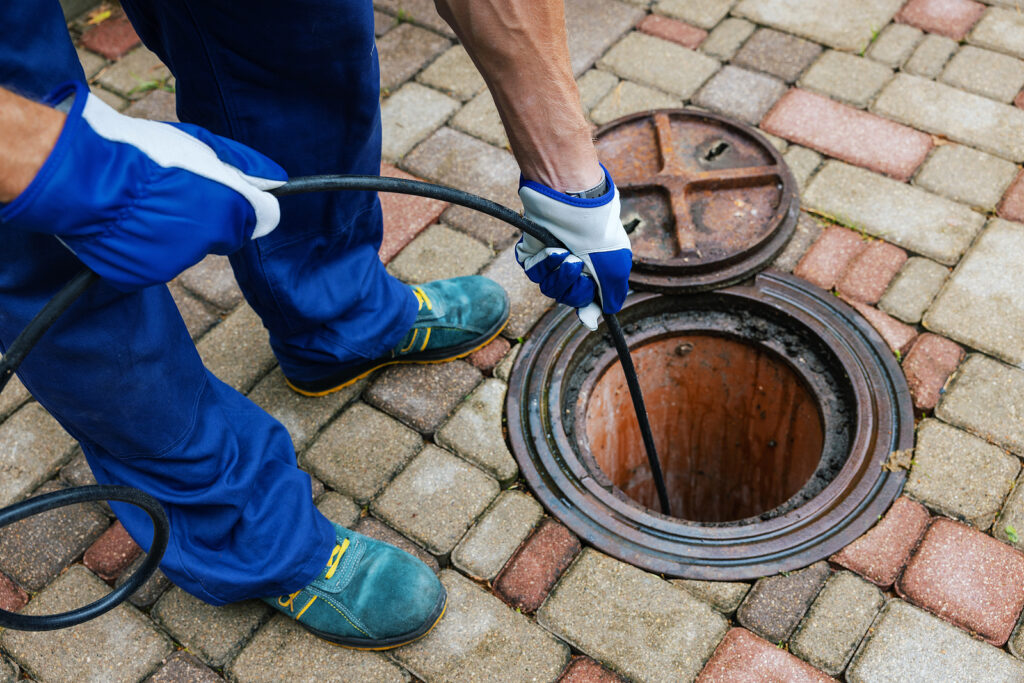
For straightforward blockages — a grease mass, a soft root intrusion, an accumulation of debris that hasn’t had years to consolidate — we use a heavy-duty mechanical auger specifically designed for sewer lines. This is different from the small drain snakes used for household drains. Sewer rods are larger, more powerful, and designed to work through the full diameter of a main sewer line rather than just clearing a path through it.
Rodding restores flow quickly. It’s appropriate for first-time blockages, relatively recent accumulations, and situations where the primary goal is getting the line flowing again as quickly as possible.
Hydro Jetting for Sewer Lines
When the camera shows significant buildup, when roots have gotten into the line, or when a blockage keeps coming back after rodding, hydro jetting is what actually solves the problem.
The equipment used for sewer line hydro jetting is more powerful than what we use for household drains — operating at pressures up to 4,000 PSI with flow rates designed to move material through the full diameter of a main sewer line. The nozzle configuration blasts forward to break through blockages and backward against the pipe walls to scour off the buildup that’s been accumulating for years.
For root intrusion in the early to moderate stages — roots have gotten into the pipe but haven’t yet cracked or broken it — hydro jetting cuts through the root mass and flushes it out. Combined with a root treatment applied to the line after cleaning, this can significantly extend the time before roots become a problem again.
For grease-heavy sewer lines — particularly in properties with heavy cooking activity — hydro jetting is the only method that actually removes the coating from the pipe walls rather than just punching a channel through it.
After hydro jetting, we run the camera through again. We want to see what the line looks like clean, confirm that the problem has been fully resolved, and document the pipe’s condition after service.
Root Treatment
After clearing a sewer line that had root intrusion, we can apply a root inhibitor treatment — a foaming compound that coats the interior of the pipe and discourages root regrowth for an extended period, typically one to two years. It doesn't kill the trees above. It treats the pipe interior specifically. This is a maintenance step, not a one-time cure. Roots come back. But regular treatment combined with periodic cleaning keeps the problem manageable and avoids the severity of a full blockage.
How often should you schedule maintenance?
The industry standard is twice a year — once in spring before cooling season and once in fall before heating season. If you can only do one, fall is typically higher priority because heating system failures carry more risk than cooling failures in cold weather. Our maintenance plan: Ask us about our annual service agreement, which covers both seasonal tune-ups at a discounted rate, includes priority scheduling, and gives you preferred pricing on any repairs needed during the year.
How We Diagnose Sewer Line Problems
Here’s something worth understanding about sewer cleaning service: the problem you can see — the backup, the odor, the slow drains — is a symptom. Treating the symptom without understanding the cause is why people have the same sewer problem six months after paying to have it cleared.
We start with a real diagnosis.
Sewer Camera Inspection
Before we recommend any cleaning method or any repair, we want to see what’s actually in the pipe. We feed a high-definition waterproof camera into the sewer line through your cleanout access point — a capped pipe fitting that’s usually located in the basement, a utility room, or outside near the foundation. The camera travels through the line and sends back live video that we watch on a monitor at the surface.
What we’re looking for: root intrusion and how extensive it is, grease and debris buildup and how thick it’s gotten, cracks or fractures in the pipe wall, sections that have shifted or offset at joints, areas where the pipe has bellied or sagged, and the overall condition of the interior surface throughout the line’s length.
You see the same footage we see. We explain what we’re looking at in plain language. At the end of the inspection, you have a clear picture of what’s going on in your sewer line — not a guess, not a general recommendation, but specific information about a specific pipe. That information determines what we recommend next.
We also use camera inspection to locate the pipe underground. A signal transmitter on the camera head lets us pinpoint its location and depth from the surface — so if excavation turns out to be necessary, we know exactly where to dig.
Recognizing the Warning Signs
You shouldn't need a camera to know when to call us. These are the signals your sewer line sends before things get serious:
- Multiple slow drains
- Gurgling sounds from multiple fixtures
- Sewage odors indoors
- Water backing up in unexpected places
- Sewage smell or wet ground in the yard
- Recurring blockages in the same area
What our Heating tune-up includes
Multiple slow drains. If one drain is slow, that’s a drain problem. If two or more drains in different parts of the house are running slowly at the same time — especially on different floors — the problem is almost certainly in the main sewer line, not in the individual drains.
Gurgling sounds from multiple fixtures. When you flush a toilet and a drain across the house gurgles, that’s air being displaced through the system — a sign that something is partially blocking the main line and creating pressure variations.
Sewage odors indoors. Sewer gas should never enter your home. When it does — when you smell something that’s unmistakably sewage inside the house, not just at a drain — it means there’s either a break in the line or a dry trap somewhere, but it’s worth having the line looked at.
Water backing up in unexpected places. Flushing the toilet causes water to back up into the shower. Running the washing machine causes water to come up through a floor drain. Any time using one fixture causes another to behave abnormally, your sewer line is telling you something.
Sewage smell or wet ground in the yard. A sewer line that’s cracked or broken underground will saturate the soil above it. If there’s an area of your yard that’s inexplicably wet, lush, or foul-smelling, you may have a sewer line breach below.
Recurring blockages in the same area. If you have a drain or toilet that keeps blocking every few months despite being cleared each time, the problem isn’t in the drain — it’s in what the drain feeds into.
FAQ
Why Choose Alassfar Drain Services LLC for HVAC Service?
If your drains are running slow, if you’re getting odors you can’t explain, if you’ve had a backup or you just haven’t had your sewer line looked at in years — call us. A camera inspection takes less than an hour and gives you a complete picture of what’s going on in the one pipe your entire plumbing system depends on.
We’ll tell you what we find. If everything looks good, we’ll tell you that too. If something needs attention, we’ll explain exactly what it is and what fixing it involves. No runaround.
For most residential properties, a sewer camera inspection every 2 to 3 years is a sensible baseline — more frequently if you have mature trees on the property, if the house is older, or if you've had sewer issues in the past. Cleaning frequency depends on what the inspection shows. Some lines need cleaning annually; others are clean after three years and can go longer. The camera tells us — we don't guess.
You can slow the process with root inhibitor treatments applied after cleaning, and by being thoughtful about what you plant near the sewer line's path. But if you have large, mature trees on the property — particularly willows, maples, or oaks, which are aggressive in their root systems — complete prevention isn't realistic. Regular inspections and timely cleaning are the practical answer.
One drain slow or blocked — drain problem. Multiple drains affected simultaneously, gurgling when another fixture is used, or sewage odors anywhere in the house — almost always a sewer line problem. The two require different equipment and different approaches, which is why diagnosing correctly at the start matters.
Standard homeowner's policies cover sudden, accidental damage — a pipe that breaks without warning. They typically don't cover gradual deterioration, maintenance issues, or root intrusion that developed over time. Some policies offer optional sewer backup riders that extend coverage to these situations. Check your specific policy and ask your insurer. What we can tell you is that having documented camera inspection records works in your favor if a coverage dispute arises.
A camera inspection runs 30 to 60 minutes for a typical residential line. Adding hydro jetting brings the total to 1.5 to 3 hours depending on the line's length and the extent of buildup. We'll give you a realistic time estimate before we start.
Absolutely yes — particularly for any home over 20 years old. Standard home inspections don't include sewer line inspection. A camera inspection before purchase tells you exactly what you're taking on. We've done pre-purchase inspections that revealed collapsed sections, severe root intrusion, and decades of grease buildup that the buyers had no idea existed. The cost of the inspection is nothing compared to discovering a $10,000 sewer line replacement after you've closed.
When Cleaning Isn't Enough: Sewer Line Repair
Sometimes the camera shows us something that cleaning won’t fix. A section of pipe that’s collapsed. A joint that’s offset far enough that the pipe interior is misaligned. A crack long enough that the surrounding soil is entering the pipe. A bellied section that will keep collecting debris regardless of how often the line is cleared.
In those situations, repair is the conversation we need to have. The options depend on what the pipe looks like, how accessible it is, and how extensive the damage is.
Spot repair involves excavating to the damaged section specifically — not the whole line — and replacing that section of pipe. When the damage is localized, this is the most efficient approach.
Pipe lining (CIPP) is a trenchless repair method where a flexible liner impregnated with resin is inserted into the damaged pipe and cured in place, creating a new pipe surface inside the old one. It doesn’t require excavating the full length of the line. Not every pipe or every type of damage is a candidate for lining — the structural condition of the existing pipe has to support it — but when it’s appropriate, it’s significantly less disruptive than excavation.
Full sewer line replacement is what the situation calls for when a pipe is too far deteriorated for targeted repair or lining. It’s a bigger project, but it’s also a permanent solution with decades of reliable service ahead of it.
We don’t push toward the most expensive option. We show you the camera footage, explain what it means, walk you through the repair options and what each involves, and give you a written estimate. The decision is yours.
Sewer Cleaning for Commercial Properties
Residential sewer lines and commercial sewer systems operate at very different scales. An apartment building, a restaurant, a retail complex, or an office building pushes significantly more volume through its sewer system than any single home — and the consequences of a sewer failure in a commercial setting go beyond property damage to operational shutdowns, health code violations, and liability exposure.
We work with commercial property owners and managers to develop sewer maintenance programs that match the actual demand on the system. For restaurants and food service operations, that means regular scheduled hydro jetting intervals that keep grease from accumulating to the point of blockage. For apartment buildings, it means periodic camera inspections and cleaning on a schedule that catches problems before tenants start complaining.
Preventive commercial sewer maintenance costs a fraction of what an emergency cleanup and repair costs — and it eliminates the operational disruption entirely.